
Cannabis THC Percentage: What It Means and Why Higher Isn’t Always Better
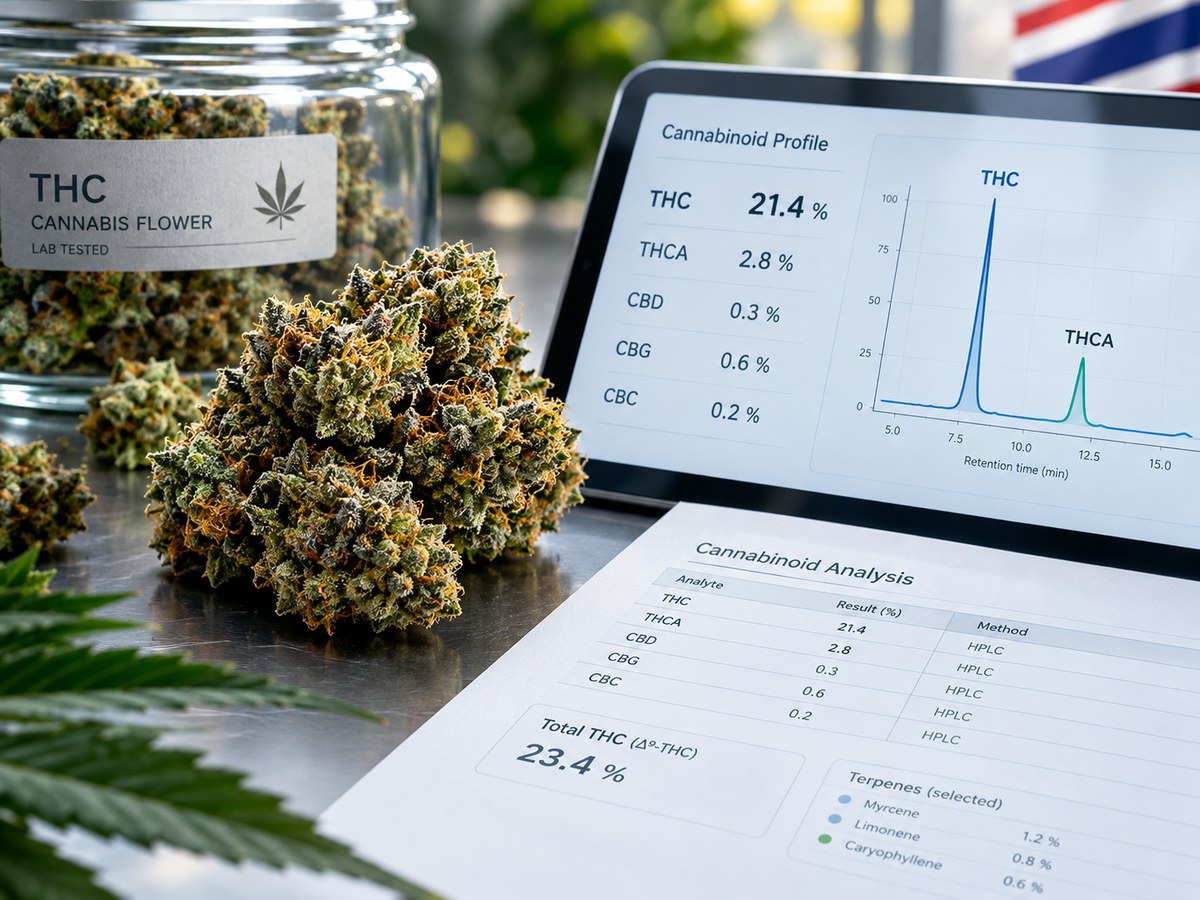
THC percentage is one of the most visible numbers on cannabis packaging and laboratory reports. Because of that, it is often treated as a simple ranking: the higher the number, the better the product.
In reality, THC describes only one part of the chemical profile of a tested sample. It does not by itself describe cultivation quality, contamination control, storage, traceability or the overall condition of the batch.
What is THC?
THC, or delta-9-tetrahydrocannabinol, is one of the major cannabinoids found in cannabis and the principal compound associated with its intoxicating effects.
When a laboratory reports THC content, the result represents the concentration measured in the submitted sample. The exact reporting format should always be checked in the individual COA.
What does THC percentage mean?
The percentage describes the concentration of THC in the material that was analysed.
The important word is sample. A laboratory examines selected material from a batch rather than every individual flower. The result therefore characterises the tested sample and should not be interpreted as proof that every part of the batch is chemically identical.
THC vs THCA
In fresh plant material, much of the potential THC may initially be present as THCA, or tetrahydrocannabinolic acid.
THCA and delta-9 THC are different compounds. When exposed to heat, THCA can undergo decarboxylation and convert into THC.
This is why a detailed laboratory report may list THC and THCA separately and may also provide a calculated Total THC value.
What is Total THC?
Some laboratories calculate a potential total THC value that takes THCA into account.
Such calculations commonly use a conversion factor reflecting the molecular-weight difference involved when THCA converts to THC. However, the exact formula and reporting convention should be checked in the laboratory report itself.
Two large numbers from different COAs should therefore not be compared automatically without first understanding what each laboratory calls THC or Total THC.
Why do different batches test differently?
Even plants sold under the same strain name do not necessarily produce an identical chemical profile in every harvest.
Genetics, cultivation conditions, harvest, post-harvest handling, product age and batch variation can all influence the tested material.
We cover the wider production chain in What Affects Cannabis Quality →
Why can laboratory results differ?
The analytical result depends not only on the plant but also on the testing process.
Sampling and sample preparation, analytical methodology, equipment, measurement conditions and reporting conventions can all affect the final number.
Small differences between reports therefore do not automatically indicate an error or falsification. The laboratory, method and sample identity provide important context.
Does higher THC mean higher quality?
No. They describe different things.
A high THC result primarily describes the concentration of one cannabinoid in the tested sample. Overall product quality involves many additional factors.
THC percentage does not tell you how the plant was cultivated, whether relevant contaminants were tested, how the product was stored or whether the batch can be traced.
Why is 30% THC not automatically better than 20%?
If the only comparison is THC concentration, the higher result represents more of that compound in the tested sample.
But the word better implies a broader judgement of product quality, and one laboratory number cannot provide that assessment by itself.
A lower-THC batch may have clearer traceability, better-documented production or more relevant and recent laboratory information.
What about CBD and other cannabinoids?
Cannabis contains more than THC. Laboratory reports may list CBD, CBDA, CBG, CBC and other cannabinoids separately when they are included in the testing panel.
A broader cannabinoid profile provides more chemical information about the sample than THC alone.
Terpenes
Terpenes are aromatic compounds that contribute substantially to the smell of cannabis plant material.
Some expanded laboratory reports include a terpene profile. This can describe selected volatile compounds in the sample, but it should not be confused with THC potency.
Why storage and age matter
A laboratory result describes material at the time it was tested.
After testing, the product continues to be affected by time, temperature, light, air and packaging conditions. An older COA is therefore best considered together with its testing date and batch information.
How to compare two COAs
Do not compare only the THC number. Check the batch identification, testing date, laboratory, THC and THCA reporting format, units, tests performed and whether each report actually belongs to the product being compared.
See How to Read a Cannabis COA → for a detailed guide.
Where does GACP fit?
THC and other laboratory results describe the tested material. GACP addresses a different question: how cultivation and collection were managed.
That is why production standards and laboratory results provide more useful context when viewed together.
Read our comparison of GACP vs COA →
The takeaway
THC percentage is a useful piece of chemical information, but it is not a universal quality score.
A more complete picture includes batch → date → THC and THCA → other cannabinoids → laboratory tests → origin → cultivation → storage.
This is why the idea that “higher THC is always better” oversimplifies how cannabis quality is actually evaluated.
Continue with What Affects Cannabis Quality →, How to Read a Cannabis COA → and Thailand Cannabis GACP →