
GACP vs COA: How Cannabis Quality Is Checked in Thailand
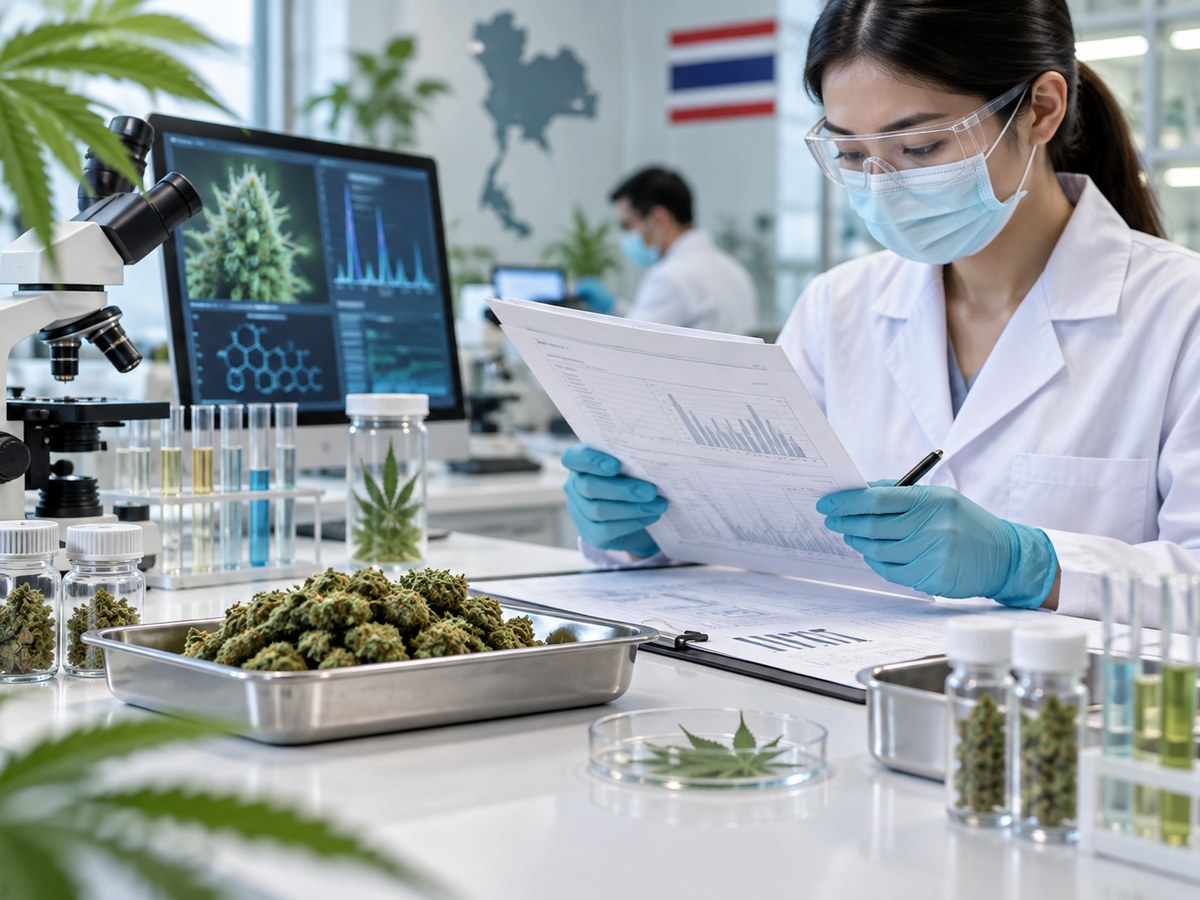
When discussing cannabis quality in Thailand, two abbreviations often appear: GACP and COA. They are sometimes treated as interchangeable certificates, but they answer different questions.
In simple terms: GACP describes how a medicinal plant is cultivated and collected, while a COA reports laboratory findings for a particular sample or batch.
What is GACP?
GACP stands for Good Agricultural and Collection Practices. It is a framework for the cultivation, collection and initial handling of medicinal plant materials.
The process can involve cultivation conditions, hygiene, materials used, contamination prevention, harvesting, storage and documentation.
We explain the framework in more detail in our guide to Thailand Cannabis GACP →
What is a COA?
COA stands for Certificate of Analysis.
Unlike GACP, laboratory analysis focuses on the particular sample submitted for testing rather than the entire cultivation system. The resulting report describes characteristics measured in that sample.
The contents of a COA depend on the laboratory, the testing programme and the applicable requirements, so not every COA contains exactly the same set of results.
The main difference between GACP and COA
The distinction can be summarised simply:
GACP → how the plant was cultivated and collected.
COA → what laboratory testing found in a specific sample.
They represent different layers of quality control, so one should not automatically be treated as a substitute for the other.
What can a COA show?
Depending on the testing programme, a report may include cannabinoid information such as THC and CBD together with the results of particular safety tests.
Broader testing may cover selected categories of contaminants, such as microbiological indicators, heavy metals or residual substances. However, the tests actually listed in the document matter: the words Certificate of Analysis do not automatically mean that every possible contaminant was tested.
Why laboratory testing does not replace traceability
A laboratory report describes the tested sample at a particular point in time.
By itself, it does not explain the complete cultivation history — where the plant was grown, what procedures were followed at the cultivation site, how it was harvested or how production records were maintained.
This is where a framework such as GACP addresses a different part of quality assurance.
Why GACP does not answer every question either
A controlled cultivation process does not replace information about a particular batch.
Laboratory testing remains a separate source of information about the composition and tested characteristics of the submitted material.
How to read a COA
When reviewing a laboratory report, look beyond the largest THC or CBD number.
Check whether the document identifies the sample or batch, the testing date, laboratory, analytical methods and the tests that were actually performed.
The report should also be connected to the specific material or batch it is being used to describe.
Potential red flags
The presence of a PDF or image labelled as a certificate does not automatically establish traceability.
It is worth asking questions when a report cannot be connected to a particular batch, has no clear date or laboratory information, is significantly outdated or shows only a cropped section without identifying the tests performed.
Which matters more: GACP or COA?
It is more useful to think of them as different components rather than choosing one over the other.
A simplified quality chain might look like this:
origin → cultivation → harvest → laboratory testing → documentation → traceability.
GACP primarily relates to the earlier stages of that chain, while a COA provides information about the sample that was analysed.
What does this mean for consumers?
For consumers, overall transparency is more informative than a single number or certification logo.
Clear origin, documented production practices and relevant laboratory results together provide a more complete picture than any single element on its own.
The takeaway
GACP is primarily a cultivation and collection framework. A COA reports analytical results for a particular sample or batch.
They do not necessarily replace each other. Each describes a different part of product quality and traceability.
Continue with our guide to Thailand Cannabis GACP → or read our overview of cannabis rules in Thailand →